Cultivating Agroecology: Celebrating 42 Years of Landless Workers’ Movement
Be The Earth is proud to support Agroecology Fund as one of our pooled funds: a force of many and diverse voices, mobilising resources to build power that transforms food systems and fosters the well-being of people and the planet.

Celebrating 42 years of Brazil's Landless Rural Workers’ Movement (MST), we reflect on the recent visit of grassroots leaders from 60 countries to the Florestan Fernandes National School, where knowledge becomes social change.
By Mariángeles Guerrero / Agencia Tierra Viva
From São Paulo
“Flowers are not edible, but we plant them because we like to work among flowers.”
Young Thais Rodrigues da Silva walks through plots of sweet potato, cassava, parsley, scallions, and leeks that she tends with her mother in Nova Esperança I, a settlement of Brazil’s Landless Rural Workers’ Movement (MST) located north of São Paulo. In that corner of the Paraíba River Valley, the breeze carries the scent of freshly cut salad greens. Flowers guard the crops, spreading pink, yellow, and orange petals—splashes of color against the dense green of land occupied to produce healthy food.
Rodrigues da Silva is an MST member and tends the gardens with her mother, Maria Francisca da Silva Cardoso. Nova Esperança I is located in the municipality of São José dos Campos, in the state of São Paulo. Sixty‑three families live there. Nova Esperança I is one of six settlements—home to 331 families—that the MST promoted in the peri‑urban area of São Paulo to supply fresh food to the country’s most populous urban region.
She served as a guide during a knowledge‑exchange visit among organizations from 16 countries, held as part of the First International Convening on Participatory Action Research for Agroecology and Climate Advocacy of the IPA‑Global initiative. The meeting brought together activists for agroecology and climate justice from 16 countries in Guararema (São Paulo, Brazil) in late 2025.
IPA‑Global is an initiative led by the Agroecology Fund that aims to strengthen—through grants and co‑created learning spaces—multi‑sector platforms composed of small farmers, Indigenous and fishing organizations, and academics working in participatory research for advocacy in support of agroecology and climate justice, centered on local knowledge.
A Small Farmers Settlement in the Paraíba Valley
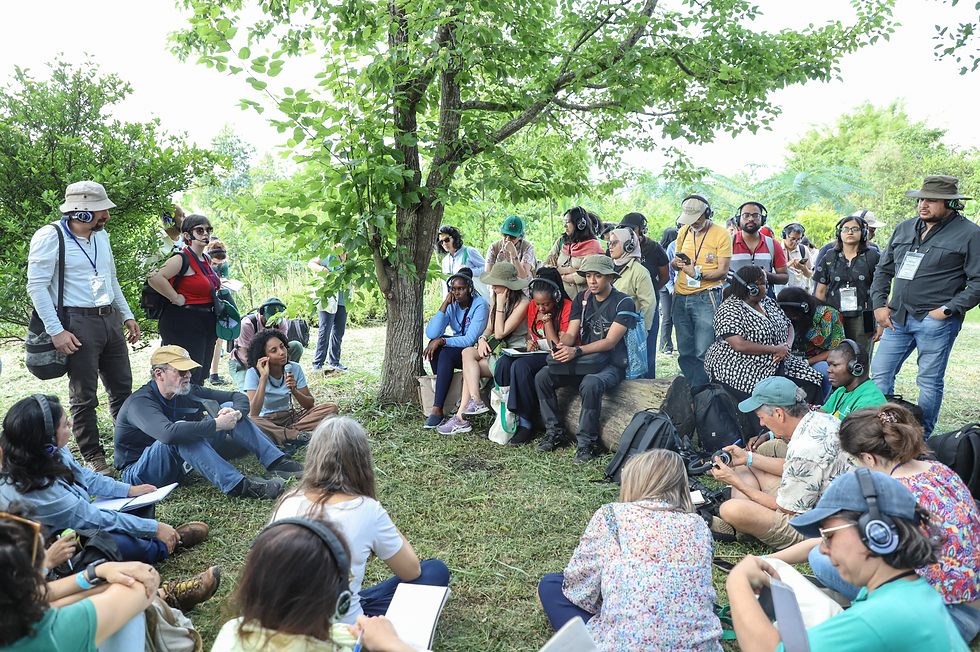
Nova Esperança I was officially recognized as an MST settlement in 2002. Families there hold the right to possess the land, but the struggle to settle began in 1997. Reclaiming those plots—once a vast, unproductive latifundium—included encampments along the Presidente Dutra Highway, which connects São Paulo and Rio de Janeiro. “There were deaths on the highway. It was a difficult process,” recalls Rodrigues da Silva, a farmer and agronomist originally from Crixás (Goiás State), who arrived at the settlement in 2017.
Since its founding in 1984, the MST has carried out 2,500 land occupations involving 370,000 families and organized 900 encampments with 150,000 landless families. Identified by their red flags and caps, the movement fights for land and food sovereignty.
The MST is the largest peasant movement in South America. Reclaiming land to produce food carries a political background of rural working‑class emancipation. That is why, in addition to farming, the movement also trains political leaders at the Florestan Fernandes National School (ENFF), located in Guararema (São Paulo State).
Rodrigues da Silva notes that agroforestry and agroecological systems in the Paraíba Valley strengthen the MST’s commitment to planting trees and producing healthy food. “You won’t find monocultures of tomatoes or strawberries here. We work with systems, and you can find forest diversity native to this territory,” she explains.
In biome terms, São Paulo State lies within Brazil’s Atlantic Forest. Rodrigues da Silva prefers the term floresta (forest) rather than mata (thicket), arguing that mata fails to convey the territory’s immensity and exuberance.
The settlement’s systems include native fruits such as cambuci—which also names a São Paulo neighborhood—and native trees like cambuí, lending its name to a major avenue in São José dos Campos. “But people in the cities don’t know where those names come from,” she says.
Alongside native flora that gives the region its identity, there are also so‑called exotic fruit trees like pineapple, lemon, and banana. “It’s strange to say bananas are exotic. They’ve been here so long that we already feel they’re ours—and in a way, they are,” she adds.
She says they receive criticism—“mainly from environmentalists”—for introducing these plants into productive systems. “It’s paradoxical, because the same people who criticize the use of ‘exotic’ species consume exotic products like rice, beans, apples, or pears at the supermarket and don’t find that odd,” she reflects.
Edible and medicinal plants are interspersed with lines of trees that provide shade. The system is designed as an ecosystem, not merely a space for production for sale.
“The problem with conventional agriculture is that it plants to serve the ‘God Market.’ We produce for ourselves first—and then for the market,” she says.
Birds fly among the gardens, building nests there. Rodrigues da Silva says the birds are companions who help with planting. “The jacú and other species plant with us. The advantage of working in an agroforestry system is that you’re not working alone,” she notes.
She and her family grow and market part of their harvest through CSA Guajuvira, an urban group of producers and consumers that finances agroecological production. Within the settlement, there are three other CSAs—Sítio Agroecológico, Sítio Guapuruvu, and Pindorama—while other families use different marketing channels.
Diversity Versus Monoculture

Eight years ago, when Rodrigues da Silva, her mother, and her husband (Altamir Bastos) began developing the agroforestry system that now includes fruits, vegetables, rice, and legumes, the fields held only brachiaria, a forage grass native to the African savanna.
Brazil’s colonial and economic history is told through cycles: sugarcane, mining, coffee, eucalyptus, and later cattle. As cattle ranching expanded, brachiaria was planted across much of the country.
The Paraíba Valley experienced eucalyptus, coffee, and cattle cycles. Today, wildfires are a problem because many ranchers use fire to manage pasture. During droughts, residents stay home, as even a small fire can wipe out the diversity they sow and cultivate.
Rows hold lettuce, parsley, beets, carrots. Rodrigues da Silva says climate shifts—such as heavy rains—will affect them less because they don’t practice monoculture. The same goes for termites and ants. “I had a neighbor who planted 2,000 cassava cuttings and asked how we managed to harvest ours while he couldn’t. It’s because we didn’t plant only cassava. In his case, ants had only cassava to eat—and ate it all. We also have fewer termites, which I believe is due to management,” she recounts.
Beyond the gardens, solitary eucalyptus trunks stand where uniform, rough green brachiaria stretches to the horizon. She explains that eucalyptus is fundamental: it serves as a perch for birds that bring seeds from elsewhere and help colonize the territory. “The problem isn’t eucalyptus—it’s monoculture, the ‘monoculture of the mind.’”
“If we planted grumichama (Brazilian cherry) in monoculture, it would cause as much damage as the coffee monoculture disaster in the Paraíba Valley. Was coffee the problem? No. We humans, caused that disaster,” she reflects.
She adds, “No plant is harmful by itself. Most of the time, the problem is us. And if we have the power to cause all this damage, we also have the power to provide the solution.”
At the end of the tour, she says: “None of what humans are doing—in Gaza or in Brazil—can be justified. We’re destroying the planet. And if there were a wonderful being who prepared a paradise for us, they’d be foolish to let us in—because we’re already destroying it.”
From City to Countryside

Despite the richness of the crops, most families in the Valley’s settlements don’t live solely from farming. Rodrigues da Silva attributes this to difficulties accessing supportive public policies. Many families come from nearby urban peripheries and are far removed from what life in the countryside entails. Before arriving, some lived on the streets—hence the need for additional support.
The settlement’s productive development has seen advances and setbacks. A few years ago, they won a bid to supply healthy food to São José dos Campos schools through a cooperative. But once the contract was lost, they couldn’t renew it due to “lack of interest from public officials.”
Last October, MST women in São Paulo State denounced that large foreign renewable‑energy companies were invading rural territories and communities, with public resources used to evict and threaten peasant families.
Despite these adversities, Nova Esperança I delivers 25 food baskets each week to the CSA group supporting the settlement: “There is another way to produce food—and more than just rice and beans to feed ourselves.”
Education and Political Training with Feet on the Ground
“Educators cannot avoid the theoretical and practical tasks they themselves must discover, coordinate, and transform into concrete facts through constructive, intelligent, and collective action.” So wrote Brazilian sociologist Florestan Fernandes in The Educational Challenge (1989). The MST’s training school in Guararema bears the name of this intellectual, who died in 1995.
From its beginnings, the MST organized courses for militants and leaders. In 1996, the need arose for a space to strengthen study, articulation, and exchange among rural and urban workers’ organizations fighting for social transformation.
With a donation from the photojournalist Sebastião Salgado and the collaboration of José Saramago and Chico Buarque, the construction of the school began in 1997. It was inaugurated in 2005. There, study is combined with work, organization, human relations, culture, philosophy, human rights, history, agroecology, and the agrarian question. A bust of Paulo Freire recalls the central role that popular education plays in this space.
At the school, culture is expressed in all its forms. A small house with the face of Mexican artist Frida Kahlo painted on its front serves as a space for artistic expression. Three agroecological gardens contribute food for students who arrive from other parts of Brazil and from various countries. The library contains materials in different languages, donated by supporters from around the world. There is also a space with games and stories for children, so that mothers and fathers can study. They explain that equal participation between men and women is important.
The goal of the school is to take knowledge into practice and words into action.
Douglas Estevam, an MST activist, explains that discussions about the use of agrochemicals and the health consequences they brought led to the central role that agroecology now plays in the movement.
“The agroecological transition was consolidated through concrete experience, until it became a central and strategic element of our program, which we call popular agrarian reform and which has agroecology and care for nature as its main pillars,” he notes.
From Brazil to Asia and Africa

Zainal Arifin Fuat is a member of Serikat Petani Indonesia (Indonesian Peasants Union). Charles Lwanga Tumuhe is part of the staff of the Alliance for Food Sovereignty in Africa (AFSA), a network promoting agroecology present in 50 African countries. Narendranath Damodaran is part of India’s National Coalition for Natural Farming (NCNF).
The three activists visited the Florestan Fernandes training school and the Nueva Esperanza I settlement during the IPA-Global meeting. In conversation with Tierra Viva, they shared how the Brazilian peasant experience connects with their own realities.
For Arifin Fuat, Nueva Esperanza I offers a lesson in how families managed to gain access to land and produce for their livelihoods. “It is important to link the struggle for agrarian reform with agriculture,” he says. He also values the production of “multiple crops instead of monocultures,” and the variety of food obtained through agroecology.
He adds: “This type of struggle is similar to that of our organization, in which we fight to obtain land and for agrarian reform. We need land and, after obtaining it, to grow food.”
Regarding the school, he values its connection “with the ideology of political economy, so that the struggle is more comprehensive.” Training and education of its members are also among the goals of the Indonesian SPI.
Lwanga Tumuhe lives in Uganda, which has had an organic agriculture policy since 2020 and is developing a national agroecology policy. He considers the school “a unique experience because activists came together to create their own learning facilities, contributed to the ideology and the curriculum.” He reflects: “It is something we must replicate in Africa, because there usually someone from outside comes, builds something, and there is very little participation from the people affected by the problem.”
Another point he highlights is the combination of political education with hands-on work on the land. “In Africa we have balanced food and healthy soil centers in ten countries. Excellent practical work and technology development are carried out there, but we lack building a philosophical foundation—in terms of a value system—of training soldiers who can wage a vigorous struggle against bad policies and challenge corporations and the injustices they bring, such as land grabbing, offering low prices for agricultural products, or dominating the market with agrotoxins,” he says.
Independence in Africa dates back six decades. But, he asserts, “we are still fighting to reclaim our independence. The former colonial masters continue to exert influence through politics, philanthropists, and multinationals.”
He explains that, in this context, there are two difficulties for food sovereignty on the continent. One is the lack of transport development, which makes it necessary for each territory to produce essential foods. The other problem is precisely related to knowledge. “At universities, students are taught that they must grow monocultures of commercial products (coffee, cocoa, tobacco) and sell them to factories, then export them to another continent and use the money obtained to buy food.”
For his part, Damodaran from NCNF highlights the importance of “learning practical things from life that make you a better person—more politically and socially aware, more capable, and better prepared to face diverse social concerns.” He adds: “It is very interesting to see how they have managed to integrate the political aspects of environmental protection, nature, and soil health, which are as political as anything else.”
Regarding the visit to Nueva Esperanza I, he emphasizes the coexistence of plants, fruits, and even ants within the system: “That is an understanding of coexistence with the rest of nature. Thaís understands agroecology from a very spiritual perspective, from the principle of coexistence, and from a technical perspective with zero chemicals, multiple crops, and the use of recycling and biomass.”
The MST has more than 40 years of collective construction in the countryside and in the political training of the peasantry. Its experience joined the knowledge of visitors from Africa, the Americas, Asia, and Europe. The final message of the gathering is that agroecology is not only a productive practice but also a philosophy and a social movement. In Thaís’s words, it was also evident that the empowerment of women working from this perspective is steadily growing.
The journey through the conceptual aspects of the Landless Rural Workers’ Movement and the beauty and abundance of the gardens at Nueva Esperanza I planted a seed: the importance of agroecology and peasant organization—a seed to continue multiplying around the world.
Photo Credits: Priscila Ramos