
Matriarchs Rising: Vamanana va tiko va le ku pfukeni
Updated: Jun 30
Written by our Aura Midwives: Amogelang Pila Ditlhale, Keamo Rakgoadi, Piwo Magqira, Quentan Marule, Vuyokazi Mnyengeza
Images captured by Goitseone Mokhonto
Two days before International Women’s Day, something quietly powerful unfolded in a village near Orpen Gate in Acornhoek, Mpumalanga.
It did not begin with a grand announcement. It began, as many regenerative movements do, with relationship.
A call between women. A remembering. A shared yes.

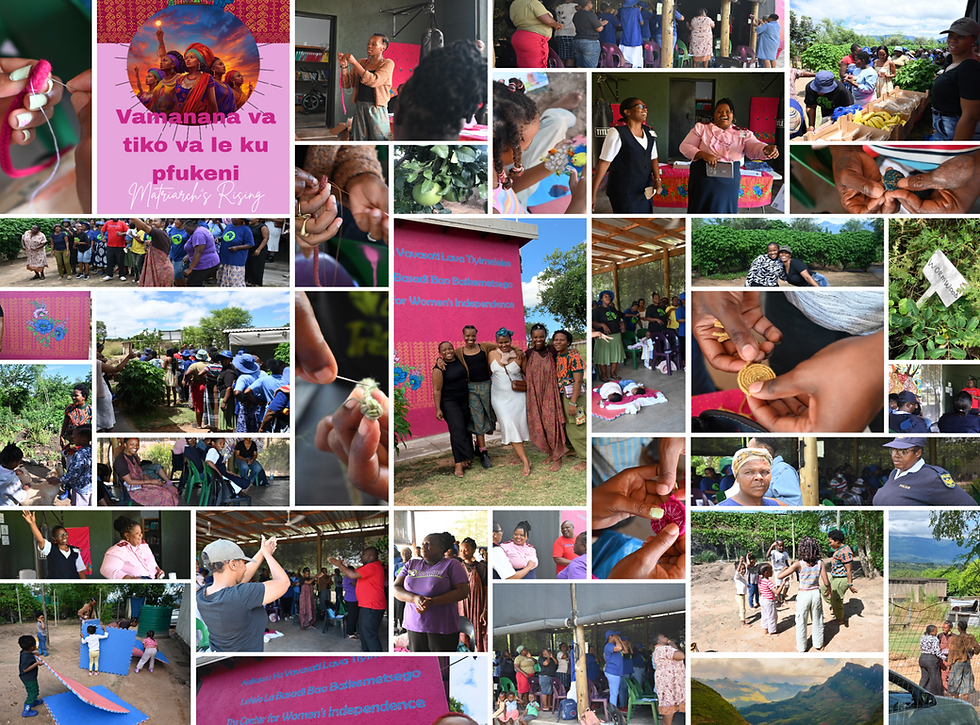
Through the initiative Sekwanele, convened by Quentan Marule, a gathering was held at the Centre for Women’s Independence—a space still in the process of naming itself, much like the living, evolving work it holds.
What emerged was more than an event. It was a field of practice.
Women came together not simply to attend, but to participate in something deeper: to learn, unlearn, and relearn—together. To sit with difficult truths, to reconnect with their bodies and creativity, and to remember the power of collective care.

The Journey as Threshold
The journey to Mpumalanga was, in itself, part of the work.
There is something quietly powerful about the beginning of relationships—how they unfold from simple gestures: a greeting, a shared drink, a car ride filled with women responding to an inner calling.
Travelling across bioregions with children, stories, and a shared playlist became a kind of moving circle. A softening. An opening.
As one reflection offers:
“I felt the beauty of being in community with women who are learning, unlearning and remembering themselves.” — Amogelang Pila Ditlhale
By the time the incredible women of Orpen Gate Village arrived, something had already shifted.
A Space to Meet What Is and What Is Possible
This gathering was rooted in both celebration and confrontation.
Conversations around gender-based violence and femicide in South Africa were held with honesty and care, supported by voices from healthcare and public safety. These were lived realities, met not in isolation but in collective witnessing.
And alongside this, something equally vital unfolded:creation, play, and restoration.
Hands began to move.
Through earring weaving, facilitated by Amogelang Pila Ditlhale, women entered a tactile process of making—using wool, thread, and needle. Language barriers softened as hands took the lead.
“A gentle reminder that art carries its own language; one that remembers what our spirits already know.” — Amogelang Pila Ditlhale
In another part of the space, children gathered in nature-based play, held by Piwo Magqira. Their laughter echoed through the day—an essential rhythm within the wider field.
“What was outstanding on my end is experiencing kids being free as they should be… seeing a community of people coming together sharing ideas and ways to grow.” — Piwo Magqira
At the heart of the gathering, Quentan held space for a deeply embodied experience—one that moved beyond discussion into inner restoration. While speaking to the importance of self-defense and protection, she guided the women through a self-love and affirmations meditation.
In this gentle yet powerful practice, women were invited to return to themselves—to soften, to affirm their worth, and to reconnect with a sense of inner safety and dignity.
It was a quiet, profound moment.
A remembering: that protection is not only external, but something we cultivate within.
The Invisible Threads That Hold
Supporting the flow of the day was Vuyokazi Mnyengeza, whose presence moved fluidly between content creation, coordination, and the many unseen acts of care that hold a gathering together.
Her reflection speaks to the subtle power of what was created:
“The invitation was simple: to show up and bring our aura. That simplicity set the tone for a gathering that felt open, supportive, and deeply intentional.” — Vuyokazi Mnyengeza
These invisible threads are not always named, yet they often what allow a space to truly land.
Seeds That Travel, Roots That Grow
This moment did not happen in isolation.
It is part of a wider ecosystem of relationships—nurtured through the Aura community and inspired by experiences such as the Facilitating the Feminine journey within the Be The Earth network.
For Quentan, the seed of this gathering was planted during her time at a Facilitating the Feminine retreat. It was there that she experienced what it means to be held in a space shaped by care, intention, and presence.
Her reflection carries this lineage forward:
“The retreat showed me how powerful it can be when women gather in a safe and supportive environment… it planted a seed that is now beginning to grow in our community.” — Quentan Marule
What was once received has now been offered onward.
A seed, becoming a garden.
A Living Practice of the Feminine
There is a particular kind of power that emerges when women gather in this way.
Not performative. Not extractive.
But relational.
A village supporting a village. Women arriving not as experts, but as companions. Mothers holding space for other mothers.
As one reflection so simply affirms:
“It felt like being home away from home.” — Piwo Magqira
This is the work of the divine feminine; not as an idea, but as a lived, embodied practice.
A way of organising. A way of caring. A way of building worlds.

Regeneration as Remembering
The land, too, was part of this story.
In Orpen Gate Village, gardens once thought infertile are now thriving—offering food, medicine, and a renewed sense of agency. They have become spaces of gathering, learning, and connection.
As reflected:
“The gardens are more than a source of food… they have become a central point for connection and development.” — Vuyokazi Mnyengeza
They remind us that regeneration is not only ecological—it is relational, cultural, and deeply human.

Vamanana va tiko va le ku pfukeni — Matriarchs Rising.
This is not a singular moment, but part of a wider unfolding.
A quiet movement of women—across villages, networks, and bioregions—continuing to show up for one another.
To learn. To unlearn. To relearn. To build spaces where healing and possibility can coexist.
And to open, again and again, the portals of collective becoming.


