Beyond Metrics: Funding Indigenous-Led Conservation with Comissão Guarani Yvyrupa
Updated: 9 hours ago
Through Synchronicity Earth's pooled fund, Amazon Alliance, Be The Earth is proud to support Comissão Guarani Yvyrupa (CGY) - an Indigenous organisation that brings together Guarani collectives across the South and Southeast regions of Brazil.
We sat down with Grace lara Souza, Latin America Partner Relations Manager at Synchronicity Earth, to listen to her deep experience of collaborating with the CGY indigenous community over the years.

Looking back at your partnership with Comissão Guarani Yvyrupa, what moment or story embodies the power of Indigenous-led conservation?
The Mbya and Avá Guarani are the main guardians of the Atlantic Forest and Pampas biomes in Brazil. The Guarani are also the largest Indigenous group in the country, yet they have the least territory officially recognised by the Brazilian state and broader society.
Since the beginning of our collective journey as CGY partners in 2020, we have witnessed their incredible strength, guided by deep spiritual and cultural roots.
These roots have consistently inspired their resilience in protecting and restoring the lands they occupy, and in reclaiming those they are in the process of taking back (retomadas), even in the most complex and adverse contexts.
Over the past years, Guarani leaders have worked closely with their technical team to ensure that political mobilisation is grounded in a strong legal framework. This has enabled them to strategically advocate with government officials for both the advancement of the legal demarcation of their territories and the reparation of historical injustices.
This strategy has culminated in the protection of 65,000 hectares, including the historic reparation of 3,000 hectares from the Binational Itaipu.

The Guarani face extreme marginalisation and yet hold astonishing collective strength. What have you learned from their way of decision-making and governance?
Over the years, the AAB lead convenor and SE Latin America partner manager have had the privilege of numerous encounters with Guarani leaders.
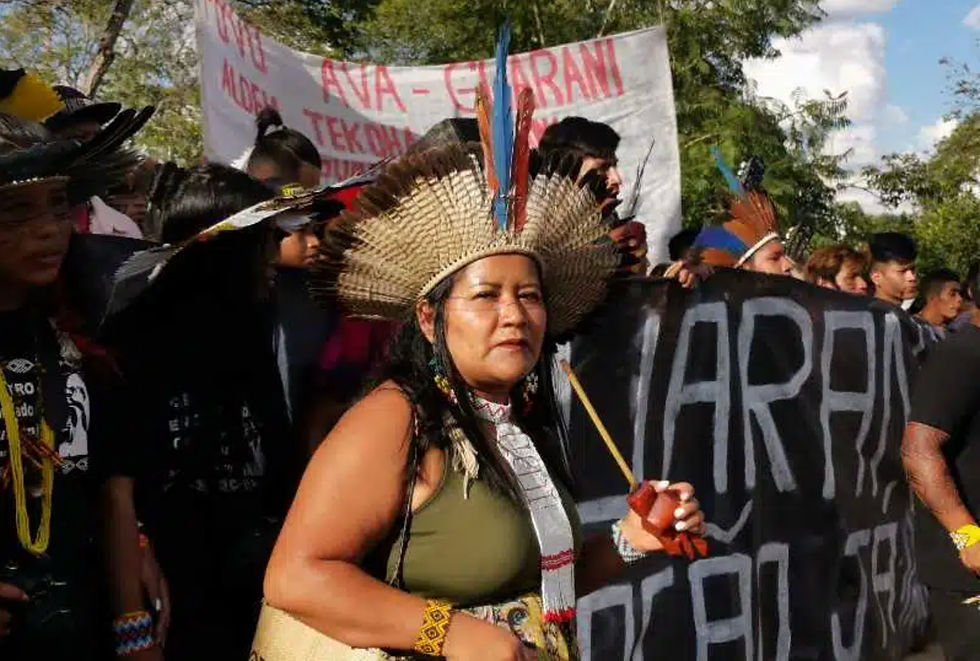
These have included accompanying leaders to global environmental governance meetings such as the UN Climate and Biodiversity Conferences; observing national Indigenous gatherings such as the Free Land Camp (ATL); joining CGY’s general assembly; and visiting tekohas, including being guests at one of the Guarani celebratory rituals of baptism of seeds and people, the Nhamongarai. These moments have been vital opportunities to nurture the relationship with CGY on behalf of the funders, as well as to learn from and witness the Guarani way of life.
Decision-making is collective, guided by their communion with Nature, their spirituality, elders, shamans, and youth.
CGY has a council of four elected Tenondés who serve as executive coordinators, representing both the South and Southeast of the country; six state coordinators; eighteen regional coordinators; and a council of appointed kunhangue (women) who ensure that the concerns and priorities of women, girls, and children are heard and respected throughout the whole Yvyrupa.
Coordinators are elected, and all live in the territory, in close connection with the realities they represent.
Each coordination meets regularly with the communities it is responsible for, conducts consultations, and, in turn, holds regional coordination meetings and strategic planning sessions. The highest decision-making body is the general assembly, which takes place every three years. CGY leaders are also supported by a technical team of Indigenous and non-Indigenous professionals who help implement CGY’s aims and objectives and deliver on the initiatives that the coordination seeks to achieve.
In supporting pooled funds like this one, what tensions have you faced between Western philanthropy and Indigenous ways of organising — and what breakthroughs?
As convenors of a collective of funders, we have tried to be mindful and to maintain ongoing dialogue with the CGY team, leaders, and funders to sustain our partnership and collective learning journey.
One of the main challenges has been ensuring that funder requirements for paperwork, or even requests for support beyond funding, are not unduly demanding or imposing.
As part of our partnership, CGY sets the key priorities for support and the overall fund allocation, and then informs us during the reporting phase about the activities undertaken over the year to fulfil those priorities.
We have also consolidated all 12 donor reporting templates into a single template and agreed to one interim reporting call between CGY and donors, as well as end-of-year narrative and financial reporting.
This way, the CGY team does not have to write individual proposals and reports for each donor in the partnership and can instead focus their time on their vital work.

Philanthropy often chases scale and metrics. How can it also honour the subtler dimensions of Indigenous leadership — spirituality, language, memory?
Reconciling funders’ interests and needs with the realities of grassroots organisations is a significant challenge, not only because of the intrinsic interconnections between cultural and ecological elements, but also because progress, as understood from a Western perspective, takes time. Grants typically have a one- or two-year lifespan, even though the legal recognition of a territory can take decades and depends on multiple political factors beyond individual partners’ control, such as political will.
Working through a pooled fund has been very helpful for our funder group, as it has deepened and broadened our knowledge of the context and realities on the ground.
Both the AAB team and SE have also been keen to create opportunities for funders and the public, especially in the UK, to engage directly with Guarani leaders. In this way, our alliance can hear and learn directly from the Guarani people about the importance of their spirituality, rituals, language, and memory.
As a result, we have all learned a great deal from Guarani culture and from one another.
This process of sharing has also strengthened our sense of community and deepened our affection for our collective home, Earth, its guardians, and each other.
Looking ahead, what gives you hope about CGY’s struggle for territory and cultural survival?
One current CGY Tenondé recently described joining CGY as:
“being like stepping onto a boat sailing down a river, the course of which had already been charted by her ancestors; and her role as Tenondé was to take up the oar and continue rowing along that same ancestral route, without changing it or devising a new one.”
Since the beginning of our journey with CGY, we have heard from the Guarani that their work and way of life are guided by the path and dreams of their ancestors, the wisdom of their elders, and the seeds represented by their children.
Over the course of our partnership, we have learned a great deal about the Guarani people’s strength and resistance, rooted in their spirituality and manifested in their living language and rituals, as they seek to continue living well and in communion with Nature, and in the constant promotion of what they call “a land without evils and fear,” a vision they have upheld since before European arrival in the land now known as Brazil.
The Guarani people have resisted multiple forms of colonisation and assimilation for more than five hundred years, and they continue to pass this strength on to their children and to all partners who join this learning journey of caring for our collective Home with them.