The Land as Teacher: Our First Teen Programme

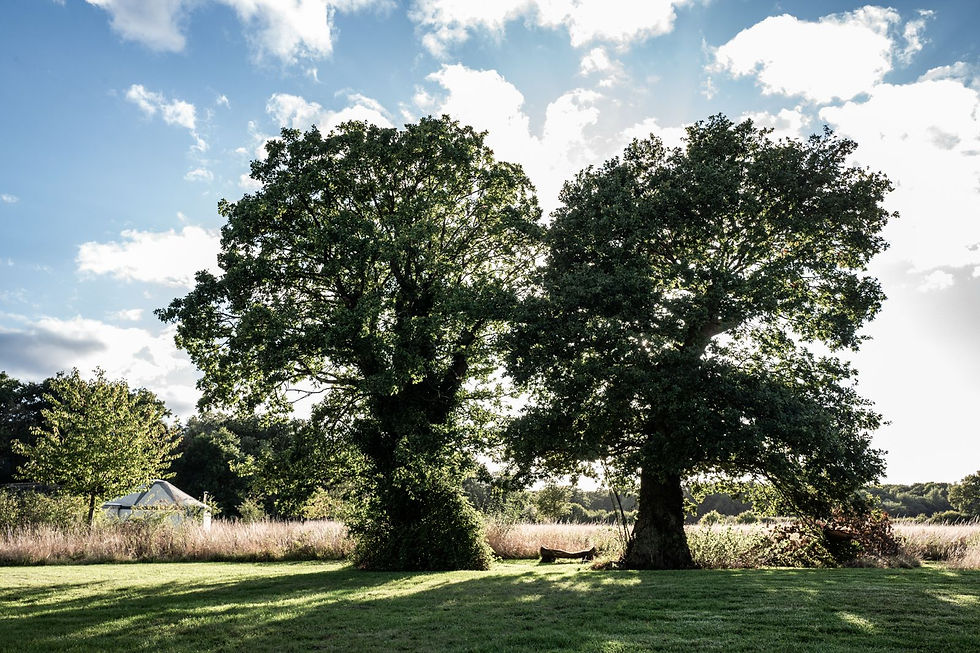
An old oak tree is a core member of our emerging community at the Be Hive in the Cape Winelands, South Africa. Rooted in the foothills of an ancient towering mountain, the oak is home to a bee hive and as of last week, a pair of Cape Eagle owls. As the humans who share this space, there might be no more than their vastly intelligent guidance that we need as we learn to navigate pathways of being, belonging and service to a more-than-human world.
Their secrets are hidden in plain view. The old oak colony of bees operating as a superorganism rather than a collective of individuals.
Regulating temperature, population and food stores together. Dividing work without central planning. Complete metamorphosis from larvae to bee. Age-related activities. Scouts, waggle dances and building consensus over a potential new site so that the whole swarm ‘decides’ together when and where to relocate. Perhaps tens of thousands of bees with no single bee in charge.
And the owls fly in utter silence. At night hooting to each other across the valley. With seems like the deepest listening that there is. With slightly asymmetrical ears, to find a sound vertically and horizontally. To locate prey and strike accurately even when it’s completely hidden. To know without seeing.
Exploring being human in a more-than-human world is hard.
The exquisite abilities of just even the bees and owls hold so much. Let alone the cosmos, ancestors, mountains, river and rocks. Perhaps it’s idealistic to look to the more-than-human for their impeccable ways of being to guide us. After all, they don’t seem to be faced with colonisation, inequality, poverty and unemployment. Nor the massive crisis of gender-based violence.

Perhaps that’s even more of a reason then to observe, pay attention and deeply listen. Not as a simplistic metaphor - rather as an intentional gaze into the infinite intelligence of all life. And to try and try again with what that may hold for us, Earth’s youngest species.
And, in our context, that means focusing on children and youth.
What creature in the entire universe does not put their offspring first? Even stars birthing in star nurseries across galaxies arrive into an environment perfectly conducive to baby stars.

Responding within our specific context, we answer an invitation to create a pilot programme for teens - the wonderful, creative age of adolescence. Not a little daunted by the competition of electronic entertainment, July’s winter saw the birth of Be The Earth’s first Teen Programme.
Not a programme that shouts. It’s simple. Direct experience. Ancient knowledge woven into practical skills. Not moralising about the state of the planet. Rather, harvesting from the Food Forest, hiking, biking, building shelters on the mountain, making fire, cooking together, being in a diverse and mixed-income group, working with clay from next to the farm dam, laughing, muddy, exhausted. Can’t wait to get back the next day. Journalling. Being teens with dreams. Ever so lightly held by young and wise facilitators. Eating sweet potato from the Food Forest the entire week made into five different recipes including chocolate mousse. Exclaiming about eating vegetarian food. Wanting to come back and volunteer in the Food Forest. The land as teacher. Beautiful teenagers connecting with land, each other and themselves through very, very old practices, skills and embodied knowledge. The kind one girl said she used to do with her grandmother. The wisdom of the feminine woven in, up, around and down.


Answers to the big questions? Not by a long shot. Except perhaps, just perhaps, trusting that the big questions are tackled by tiny, radically pragmatic and activist-type contributors. The kind that scout, waggle and swarm to a bit of a more beautiful world. The kind that can listen while silently on the wing. To locate precisely and accurately what’s needed to thrive. And then to hoot.
Eve Annecke
Programmes Curator
Jana Seiler et al, Inhibitory modulation of age-dependent behavior through dsx -expressing cells in honeybees, Proceedings of the National Academy of Sciences (2026). DOI: 10.1073/pnas.2604986123